
Meniscus Tears: Why a 17-Year-Old Athlete and a 58-Year-Old Weekend Warrior Shouldn't Be Treated the Same
If you've ever been told you have a torn meniscus, your first question is probably:"Do I need surgery?"
The answer isn't as simple as yes or no.Today's orthopedic surgeons treat meniscus injuries much differently than they did 15 years ago. Rather than removing damaged tissue, the goal is now to preserve as much of the meniscus as possible whenever feasible.The best treatment depends on your age, activity level, type of tear, symptoms, and overall knee health.What Is the Meniscus?
Each knee contains two menisci—crescent-shaped pieces of fibrocartilage that act as shock absorbers between the femur and tibia.The meniscus helps:Distribute force across the kneeImprove joint stabilityProtect the articular cartilageReduce stress that can lead to arthritis
Losing part of the meniscus increases contact pressure within the knee, which is why preserving it has become such an important goal.How Common Are Meniscus Tears?
Meniscus injuries are among the most common knee injuries seen in orthopedics.Research estimates that meniscal injuries requiring operative management occur in approximately 60-70 people per 100,000 each year, and they make up a significant percentage of sports-related knee injuries.In young athletic populations, certain sports carry a particularly high risk because they involve cutting, pivoting, and rapid changes in direction.Common high-risk sports include:SoccerBasketballFootballWrestlingRugbyTennis
One study of young athletes found the greatest rates of isolated meniscus injuries occurred in football (19%), wrestling (13%), and rugby (9%).Young Athletes: Usually an Acute Injury
In teenagers and young adults, meniscus tears often occur after:Twisting on a planted footSudden changes in directionLanding awkwardly from a jumpContact injuries
These athletes frequently remember the exact play when the injury occurred.Because younger patients typically have healthier tissue and better blood supply near the outer portion of the meniscus, surgeons often try to repair the tear rather than remove it.Which Tears Can Be Repaired?
The best candidates for repair include:Vertical longitudinal tearsBucket-handle tearsTears in the outer "red-red" or "red-white" vascular zonesRoot tears in appropriate patientsAcute traumatic tears
Modern surgical techniques have expanded the number of tears that are considered repairable compared with just a decade ago.Although recovery after repair is longer—often 4 to 6 months or more before returning to sport—the long-term goal is preserving knee health.Older Adults: A Different Type of Meniscus Tear
Adults over 40 often develop a different problem.Rather than one traumatic event, the meniscus gradually weakens over time. These are called degenerative meniscus tears.Many people don't remember a specific injury.Instead they notice:Pain with squattingStiffnessSwelling after activityDifficulty kneelingOccasional catching
It's also important to know that many adults have meniscus tears visible on MRI without any symptoms at all.Finding a tear on imaging doesn't automatically mean it is the source of knee pain.Do Degenerative Meniscus Tears Need Surgery?
Not usually.Over the last decade, multiple high-quality studies have shown that many degenerative meniscus tears respond just as well to structured physical therapy as arthroscopic partial meniscectomy, particularly when there is no true mechanical locking of the knee.Physical therapy focuses on:Restoring quadriceps strengthImproving hip strengthNormalizing movement mechanicsImproving balanceReducing joint overload
Surgery may still be appropriate if patients have:Persistent lockingLarge unstable tearsFailure of conservative treatmentCertain root tearsAssociated ligament injuries
Can a Meniscus Tear Heal Without Surgery?
One of the most common questions patients ask is whether a meniscus tear can heal on its own. The answer depends on where the tear is located and what type of tear it is.The outer one-third of the meniscus, known as the "red-red zone," has a relatively good blood supply. Because blood flow is essential for healing, tears in this region—especially in younger individuals—have a greater chance of healing, either on their own or after surgical repair.In contrast, the inner portion of the meniscus, called the "white-white zone," has very little blood supply. Tears in this area are much less likely to heal biologically.However, it's important to remember that not every meniscus tear needs to heal for symptoms to improve. Many people experience significant pain relief and return to their normal activities through physical therapy, strength training, and activity modification, even if the tear remains visible on an MRI.The decision to pursue surgery is based less on the MRI itself and more on factors such as persistent pain, mechanical locking or catching, knee instability, activity goals, and response to conservative treatment.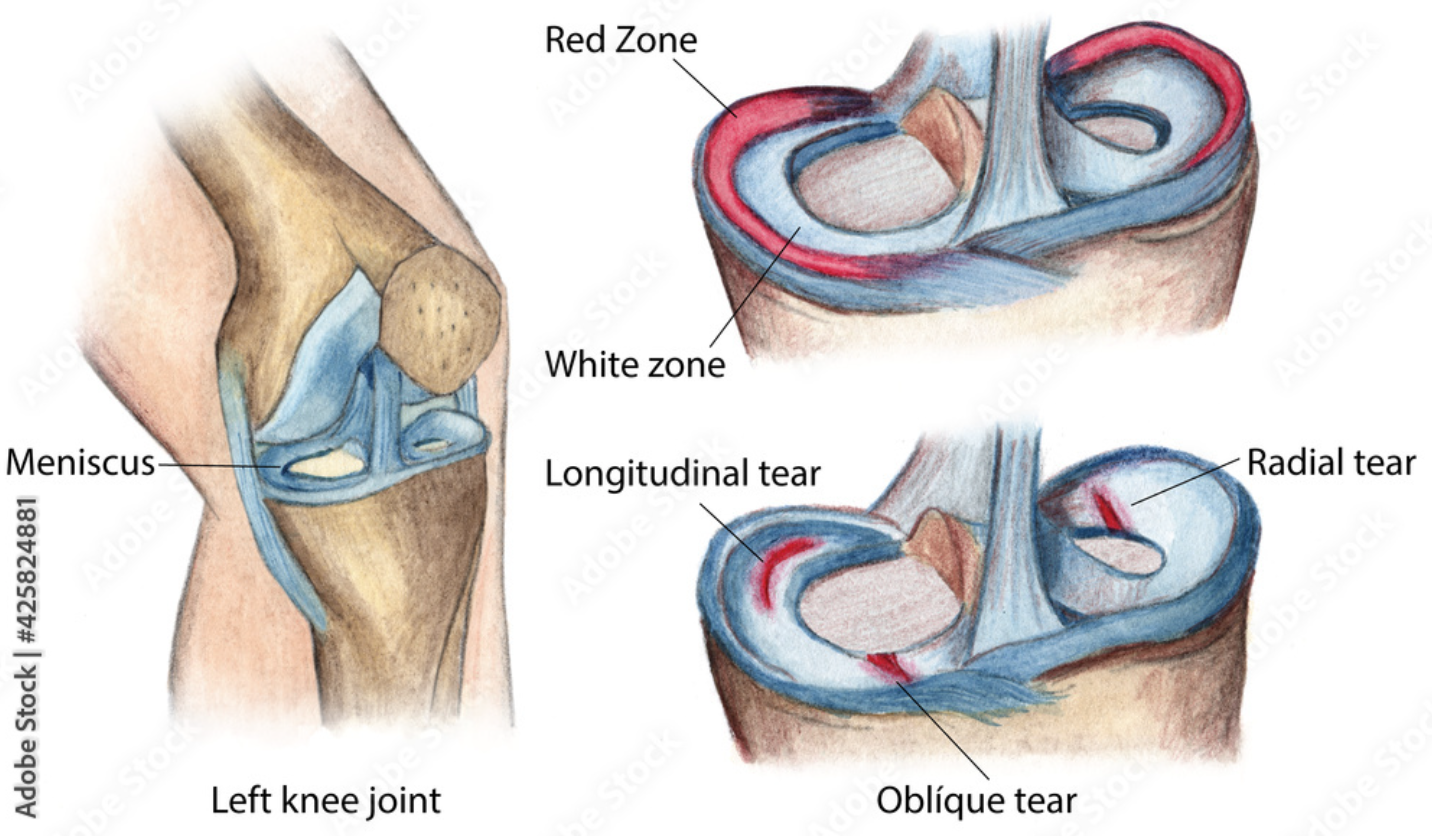
Why Surgeons Remove Less Meniscus Than They Used To
Years ago, surgeons commonly removed torn portions of the meniscus.Today, we know that removing meniscal tissue increases stress on the knee joint and may accelerate cartilage wear over time.Because of this, orthopedic surgeons now follow a simple principle:Preserve the meniscus whenever possible.Even tears that were once considered "irreparable" may now be repaired using newer surgical techniques.What About PRP and Other Biologic Injections?
Patients often ask whether injections can heal a meniscus tear.The answer is: possibly—but the evidence is still evolving.Current biologic treatments being studied include:Platelet-Rich Plasma (PRP)Bone Marrow Aspirate Concentrate (BMAC)
Researchers are investigating whether these treatments may improve healing when combined with meniscus repair or other minimally invasive procedures.While early results are encouraging for selected patients, there is not yet strong evidence that injections alone reliably heal most meniscus tears, and they are generally considered an adjunct rather than a replacement for appropriate rehabilitation or surgery when indicated.Physical Therapy Remains a Cornerstone of Recovery
Whether treatment is surgical or non-surgical, rehabilitation is essential.Physical therapy helps restore:Knee motionStrengthNeuromuscular controlBalanceRunning mechanicsSport-specific movement
For athletes, rehabilitation also includes progressive return-to-sport testing to reduce the risk of re-injury.The Bottom Line
Not all meniscus tears are created equal.A young athlete with an acute traumatic tear may benefit from preserving the meniscus through surgical repair.An older adult with a degenerative tear often improves with physical therapy and activity modification, avoiding surgery altogether.The key is matching the treatment to the individual—not just the MRI.If you're experiencing knee pain, a thorough evaluation can help determine whether your meniscus is truly the source of your symptoms and which treatment option is most appropriateAt our facility, we evaluate athletes and active adults with knee pain to determine whether physical therapy, surgical consultation, or continued activity is the best next step.For The Baldwin Park Location: Call 321-218-0435For The Winter Springs Location: Email Rachel@jsportsrehab.com