
Is Your Young Athlete Doing Too Much? A Parent's Guide to Sport Specialization and Overuse Injuries
In Central Florida, youth sports never really stop. Travel baseball, club soccer, and year-round training mean many kids play one sport twelve months a year. That commitment builds skill, but it also builds risk.
More of the young athletes we see are not hurt from a single bad play. They are hurt from doing the same movement too often, with too little rest, while their bodies are still growing.
What sport specialization means
Sport specialization is intense, year-round training in one sport, usually more than eight months a year, while giving up other sports. The American Academy of Pediatrics recommends delaying specialization in most sports until after puberty, around age 15 or 16.
Why young athletes are at higher risk
Kids are not small adults. Growth plates, the areas of developing cartilage near the ends of bones, are weaker than the tendons and ligaments around them. Repeated stress tends to injure the growth plate first.
Growth spurts add to the problem. Bones lengthen faster than muscles and tendons adapt, so flexibility and coordination often drop just as training demands rise.
Playing one sport all year also loads the same tissues the same way, every week, with no break to recover.
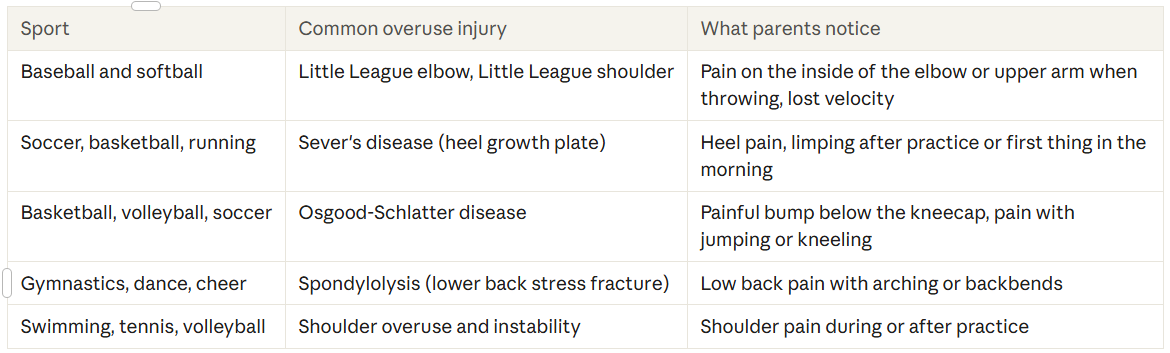
Common overuse injuries by sport
Warning signs to watch for
Pain that shows up during or after practice and keeps coming back
Limping, or changing how they throw, run, or jump
A drop in performance, speed, or accuracy
Pain at night or at rest
Losing interest, irritability, or not wanting to go to practice (signs of burnout)
Kids often hide pain so they don't lose playing time. Ask directly, and watch how they move.
Guidelines for healthy participation
These recommendations come from the American Academy of Pediatrics and the National Athletic Trainers' Association:
Hours per week should not exceed age. A 12-year-old should not train or compete more than 12 hours a week in organized sport.
Two days off each week from organized practice and games.
One organized sport per season. Avoid playing on two teams in the same sport at the same time.
No more than eight months a year in one sport. Take time away from that sport in one-month blocks.
Delay specialization until mid-to-late adolescence for most sports.
Baseball and softball players should follow pitch count and rest guidelines such as Pitch Smart, and avoid pitching on multiple teams.
How physical therapy helps
Physical therapy is not only for after an injury. At J Sports Rehabilitation, we work one-on-one with young athletes to:
Screen movement and strength using FMS and sport-specific testing to find weak links before they become injuries
Treat overuse injuries with a plan that keeps them active wherever it's safe
Build strength and control around growth spurts
Guide return to sport with clear criteria, not just a date on the calendar
If your athlete has pain that keeps coming back, or you want a baseline screen before the next season, schedule an evaluation at our Baldwin Park or Winter Springs location.